

 0
0 You have an idea for a WordPress plugin, theme, or SaaS product. You can picture exactly how it should work. The only problem? Either you can’t code it yourself, or you can code it but you don’t have the 400 hours it’ll take while running an agency, holding a day job, or managing your existing portfolio.
So you start thinking about outsourcing. And then you read three Reddit threads, two cautionary blog posts, and a horror story about a $40,000 development bill for a broken plugin, and now you’re not sure what to do.
This article won’t tell you outsourcing is always right or always wrong. It’ll give you a framework for figuring out which side of that line your project actually falls on, and what to watch out for either way.
What Outsourcing Your MVP Really Buys You
Before you can decide whether to outsource, you need to be honest about what you’re actually buying. It’s not just “code.” You’re paying for some combination of speed, expertise, and your own focus.
Speed is the most obvious one. A solo founder building part-time might ship an MVP in 6 to 9 months. A dedicated team of two or three can compress that to 8 to 14 weeks for a similar scope. That difference matters because, according to CB Insights’ analysis of startup post-mortems, “no market need” is the single most common reason startups fail, cited in 35% of cases. The longer it takes you to put something in front of real users, the longer you spend building something nobody wants.
Expertise is the second thing. WordPress looks deceptively simple from the outside, but a production-grade SaaS plugin involves areas most generalists haven’t touched: secure REST API design, multisite compatibility, internationalization, the Block Editor (Gutenberg) ecosystem, licensing systems, update servers, and compliance with the wordpress.org repository guidelines.
The plugin directory currently lists more than 60,000 free plugins, and the quality bar for getting noticed has risen sharply over the last few years. If you’ve never shipped a freemium plugin before, you’re going to make rookie mistakes in all of these areas. An experienced team has already made those mistakes on someone else’s dime.
The third thing, and the one founders underestimate most, is your own focus. Every hour you spend debugging a settings page is an hour you’re not spending on positioning, pricing, customer research, support documentation, or content marketing. For agency owners and freelancers especially, this trade-off is brutal: your billable hour rate is the real opportunity cost of every line of code you write yourself.
The Biggest Mistake Founders Make Before Hiring Anyone
Almost every failed outsourcing project starts long before the first line of code.
It starts with an unclear product.
Founders often hand developers a list of features instead of a real product specification. Developers naturally build exactly what’s written. Six weeks later, the founder realizes they actually wanted something different.

Before contacting any agency or freelancer, answer these five questions:
- What problem does this plugin solve?
- Who is the first paying customer?
- What feature would make someone pay today?
- Which features can wait until version 2?
- How will you measure whether the MVP succeeds?
If you can’t answer those questions in one page, you’re probably not ready to outsource. Every unanswered question becomes a change request later, and change requests are where budgets disappear.
When Outsourcing Actually Makes Sense
There’s no universal answer, but there are situations where bringing in outside help is clearly the smarter move. Here are the five most common ones.
- You have domain expertise, not technical depth. You understand the problem deeply, maybe because you’ve sold WordPress services for a decade, or you’ve run a niche e-commerce store and know exactly what’s missing, but you can’t translate that into code. Trying to learn PHP, React, and the WordPress REST API while validating a business idea is a recipe for shipping nothing.
- Your timeline is tied to a market window. Black Friday, WordCamp launches, a competitor’s pricing change, a WordPress core release that opens a new opportunity. If the window closes before you ship, the product doesn’t matter. Outsourcing buys back calendar time you can’t otherwise recover.
- The MVP requires skills outside your stack. You’re a PHP developer but the MVP needs a React-heavy admin UI. You’re a designer who can prototype in Figma but you’ve never written a class extending WP_REST_Controller. Filling one specific skill gap through a contractor or partner is usually cheaper than learning it from scratch.
- Your time has a higher dollar value elsewhere. If you bill clients at $125/hour and a competent WordPress developer costs $40 to $70/hour, the math is uncomfortable but clear. Every hour you spend coding is an hour of lost agency revenue, and the spread compounds across a multi-month build.
- You need a credible technical co-founder substitute for fundraising. If you’re pitching investors or applying to accelerators, a working MVP built by a serious team carries more weight than a half-finished prototype you cobbled together at night. This is one of the more common reasons founders look at startup MVP development services instead of going it alone, particularly when the goal is to walk into investor conversations with something real to demo.
If two or more of these describe your situation, outsourcing is probably the right call. If only one applies, think harder before you write a check.
When You Should Keep It In-House
Outsourcing isn’t free, and it isn’t always smart. Here are the situations where doing it yourself, or hiring a single freelancer instead of a full team, will serve you better.
- The MVP is genuinely small. If your plugin idea is a one-feature utility that could ship in 40 to 80 hours of focused work, hiring an agency to build it is overkill. The coordination overhead alone will eat your budget.
- You’re still figuring out what the product is. If your spec changes weekly because you haven’t talked to enough potential users, you’re going to burn money paying a team to rebuild the same screens four times. Validate the idea first. Build later.
- You can code, and you have the time. This is obvious but worth saying. If you’re a competent WordPress developer with 15 hours a week to spare, building the v1 yourself gives you intimate knowledge of the codebase that pays dividends for years, especially when you’re debugging customer issues at 2 a.m.
- Your budget is under roughly $5,000. Below that threshold, you’ll either get a team that doesn’t take you seriously, or you’ll get one that does take you seriously and runs out of money halfway through. Both outcomes are bad.
- You want to learn the stack. If part of your goal is to become a better WordPress developer or to deeply understand your own product, outsourcing the entire build defeats the purpose.
The honest truth is that a lot of WordPress products start as side projects from technical founders who built the v1 themselves, validated demand, and only brought in outside help once revenue justified it. Yoast, Easy Digital Downloads, and many of the early premium plugin businesses followed something close to this pattern.
A Hybrid Approach That Often Works Better
For many WordPress founders, outsourcing doesn’t have to be an all-or-nothing decision. Instead of hiring an agency to build the entire product, outsource only the parts where you’re weakest.
A common split looks like this:
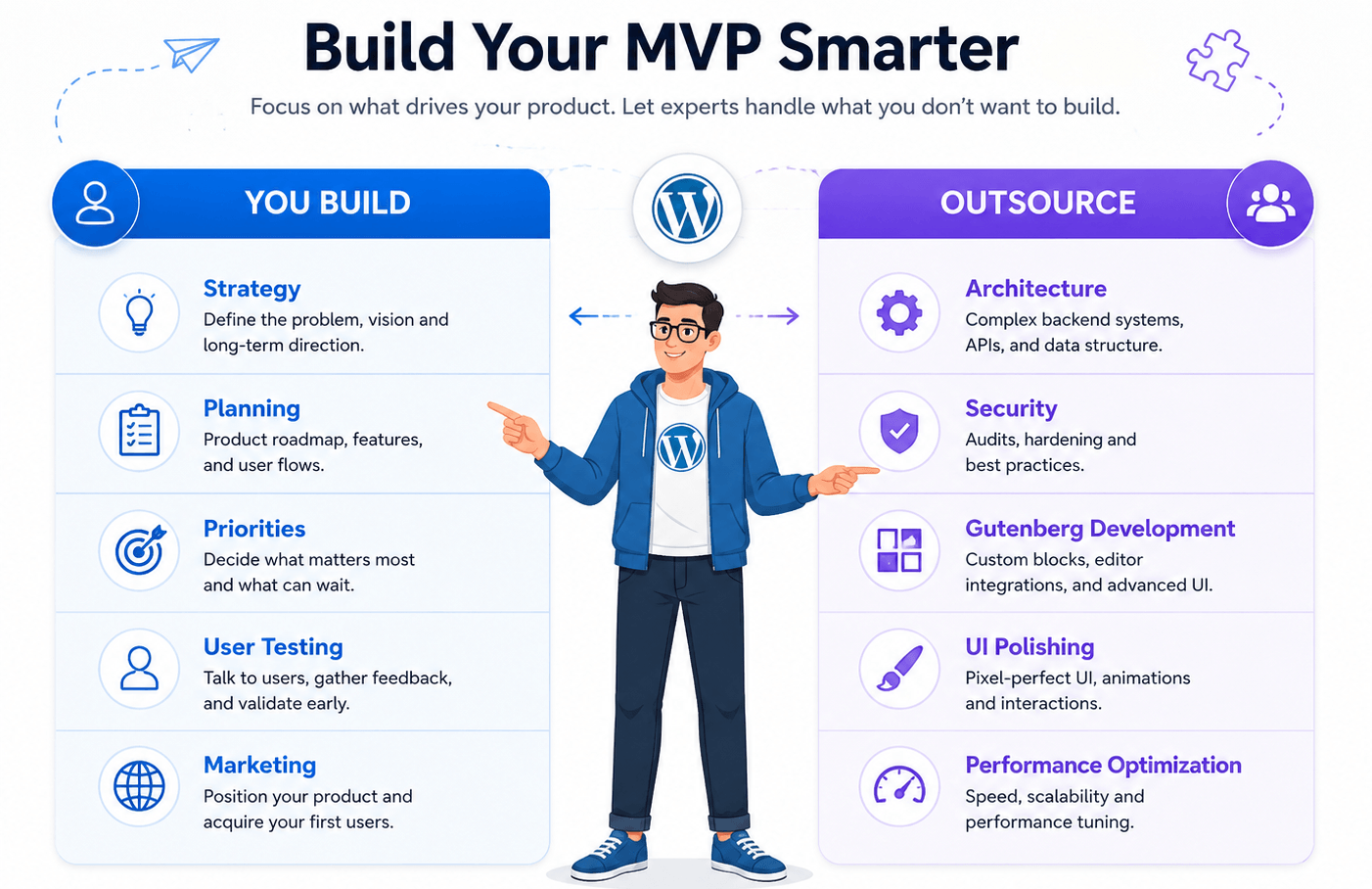
| You Build | You Outsource |
|---|---|
| Product planning | Complex backend architecture |
| Feature prioritization | Security audits |
| User testing | Gutenberg block development |
| Documentation | UI polishing |
| Marketing website | Performance optimization |
This approach gives you control over the product while reducing technical risk. It also keeps future maintenance easier because you stay involved throughout the build instead of inheriting a codebase you’ve never seen before.
How to Evaluate a Development Partner Without Getting Burned
If you do decide to outsource, the choice of partner matters more than the decision to outsource in the first place. The Standish Group’s CHAOS Report, which has tracked software project outcomes for three decades, has consistently shown that the majority of software projects either fail outright or run significantly over budget and schedule. Most of those failures aren’t technical. They’re communication failures, scope failures, and expectation failures.
Here’s a short list of things to actually verify before signing anything:
- Ask for WordPress-specific case studies, not generic web development work. A team that’s shipped a plugin to the wordpress.org repo will hit fewer landmines than a team that’s only ever built bespoke client sites. The repository’s submission process, security review, and ongoing update mechanics are their own discipline.
- Check whether they understand the difference between custom client work and product development. These are different disciplines. Product work needs versioning, update mechanisms, support documentation, license management, and a roadmap. Client work doesn’t.
- Get specific about ownership. You should own 100% of the code, the repository, and any accounts created during development, including domain registrars, hosting, GitHub, and any third-party API accounts. Get this in writing before the first invoice.
- Demand a fixed scope for v1. Time-and-materials contracts on a vague spec are how MVPs balloon to triple their original budget. Lock the scope. Save new ideas for v2 and write them down in a separate document.
- Talk to two of their previous clients without the agency in the room. A 15-minute reference call will tell you more than a 50-page proposal. Ask specifically what went wrong, not just what went well.
One more thing worth saying: the cheapest quote is almost never the best one. If three teams quote you $18,000, $22,000, and $6,000 for the same scope, the $6,000 quote is not a bargain. It’s a warning sign. Either they’ve misunderstood the scope, or they’re planning to charge you the rest in change orders once you’re locked in.
The Hidden Costs Most Founders Forget
Even with a fixed quote, the headline number isn’t the total cost. Founders consistently underestimate three categories of spend.
The first is design and UX. Many WordPress development quotes assume you’ll provide finished mockups. If you don’t, you’re either paying extra for design work or you’re letting developers make UX decisions, which rarely ends well. Budget separately for a designer who understands both web app patterns and the constraints of the WordPress admin.
The second is post-launch fixes. The first 30 days after launch will surface bugs, edge cases, and small UX problems no one anticipated. Reserve 15 to 20 percent of your build budget for this phase, and make sure your contract covers a defined warranty period.
The third is the infrastructure around the plugin itself: a licensing and update server, a support helpdesk, billing integration with Stripe or Paddle, documentation, and a marketing site. None of these are part of “building the plugin,” but all of them are required to actually sell it. Founders selling premium WordPress products commonly rely on tools like Freemius, Easy Digital Downloads, or Paddle to handle licensing and payments rather than rebuilding that infrastructure from scratch. Whichever route you choose, decide before development starts, because the choice shapes the codebase.
A fourth, easily missed cost is what happens when the outsourced team finishes and walks away. If you can’t read the code, can’t deploy it, and can’t fix a critical bug yourself, you’re locked into hiring that same team forever, at their rate, on their schedule. The fix is to insist on documentation, a clear README, a deployment guide, and at least one knowledge transfer session before the engagement ends. Better yet, bring in a part-time technical advisor who can review the code on your behalf and tell you, honestly, what shape it’s actually in.
The Decision Framework
When founders ask whether they should outsource, three questions usually settle it:
- What’s the cost of a six-month delay? If the answer is “nothing, I’m patient,” build it yourself. If the answer is “I lose the market window or burn through my runway,” outsource.
- What’s your hourly opportunity cost? Multiply it by the hours you’d realistically spend building. Compare to a realistic outsourcing quote. The numbers usually tell you the answer.
- Have you validated the idea with at least 10 potential users? If no, don’t outsource yet. Validate first. The cheapest MVP is the one you don’t build because you discovered nobody wanted it.
Outsourcing isn’t a shortcut, and it isn’t a failure. It’s a financial and strategic decision. Treat it like one. Run the numbers, check the references, lock the scope, and ship something small enough to learn from. That’s how the WordPress products that survive past year one tend to get built.



 Email Subscription Request


Add your first comment to this post